

| David Brown's Wildlife Services 12 Hotel Road Warwick, MA 01378 Tel: 978 544 8175 E-mail: info@dbwildlife.com |
| Interpretive programs * Wildlife inventories * Docent training Wildlife education planning |
| General Services |
Tracker-naturalist David Brown provides several services focused on New
England wildlife. These include:
England wildlife. These include:
- Interpretive programs, including animal tracking and bird programs
- Wildlife inventories, including both mammal tracking and bird surveys
- Docent training of interpretive walk leaders
- Wildlife education planning for organizations

Interpretive programs are mainly centered on animal
tracking, but seasonal bird programs are also provided,
mainly during spring migration and again during the fall
hawk movement.
"Eco-tracking" Although animal tracking programs begin
with identification, an effort is made to expand on this into
the area of "eco-tracking" by using an animal's tracks, trails
and other sign to interpret its relationship with the habitat in
which it is found.
Costs for sponsoring organizations can be obtained by
phone or e-mail
tracking, but seasonal bird programs are also provided,
mainly during spring migration and again during the fall
hawk movement.
"Eco-tracking" Although animal tracking programs begin
with identification, an effort is made to expand on this into
the area of "eco-tracking" by using an animal's tracks, trails
and other sign to interpret its relationship with the habitat in
which it is found.
Costs for sponsoring organizations can be obtained by
phone or e-mail
David Brown points out bobcat sign in a
porcupine runway. Photo Bart DeWolf.
porcupine runway. Photo Bart DeWolf.
Wildlife inventories are provided for private landowners and stewards of
public land to help them determine the wildlife content and value of their
property. Two types are offered:
Cost varies with size and diversity of area. Estimates can be obtained by phone
or e-mail.
public land to help them determine the wildlife content and value of their
property. Two types are offered:
- Mammal tracking surveys
- Breeding bird surveys
Cost varies with size and diversity of area. Estimates can be obtained by phone
or e-mail.
Docent training is provided to organizations such as land trusts, friends groups
and sanctuary staff for the benefit of volunteers who lead interpretive walks in
natural areas.
The method. Typically docents meet once a week for a season to familiarize
themselves with the natural history of their area and to practice skills such as
dealing with the public, giving short presentations, finding their way in the woods
and dealing with emergencies.
Cost varies with the length of training desired. Call or e-mail for an estimate.
and sanctuary staff for the benefit of volunteers who lead interpretive walks in
natural areas.
The method. Typically docents meet once a week for a season to familiarize
themselves with the natural history of their area and to practice skills such as
dealing with the public, giving short presentations, finding their way in the woods
and dealing with emergencies.
Cost varies with the length of training desired. Call or e-mail for an estimate.
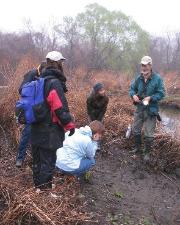
A docent class examines
tracks in mud at Alewife
Reservation
tracks in mud at Alewife
Reservation
Wildlife education planning is provided to conservation organizations, land
trusts, state parks and others who need a plan for educating the public about the
wildlife content of their lands. The area to be used is reconnoitered in detail and a
report is prepared that contains a general natural inventory and recommendations
on appropriate educational activities, siting facilities, design of curricula, and so
forth.
Cost varies with acreage, complexity of project and level of detail desired. Call or
e-mail for an estimate.
trusts, state parks and others who need a plan for educating the public about the
wildlife content of their lands. The area to be used is reconnoitered in detail and a
report is prepared that contains a general natural inventory and recommendations
on appropriate educational activities, siting facilities, design of curricula, and so
forth.
Cost varies with acreage, complexity of project and level of detail desired. Call or
e-mail for an estimate.